Race-car engineering has always been a competition between human experience, mechanical understanding, and available data. Engineers have spent decades studying lap times, tire temperatures, suspension behavior, aerodynamic balance, engine performance, braking traces, and driver feedback to find small improvements that can make a measurable difference on the circuit. In 2026, however, another tool is becoming increasingly important: artificial intelligence.
AI race engineers are beginning to change how teams collect, interpret, and use the enormous amount of information produced by a modern race car. Instead of replacing the traditional race engineer, AI systems can process large datasets quickly, identify relationships that may be difficult to spot manually, compare thousands of previous laps, and help engineers evaluate possible setup changes.
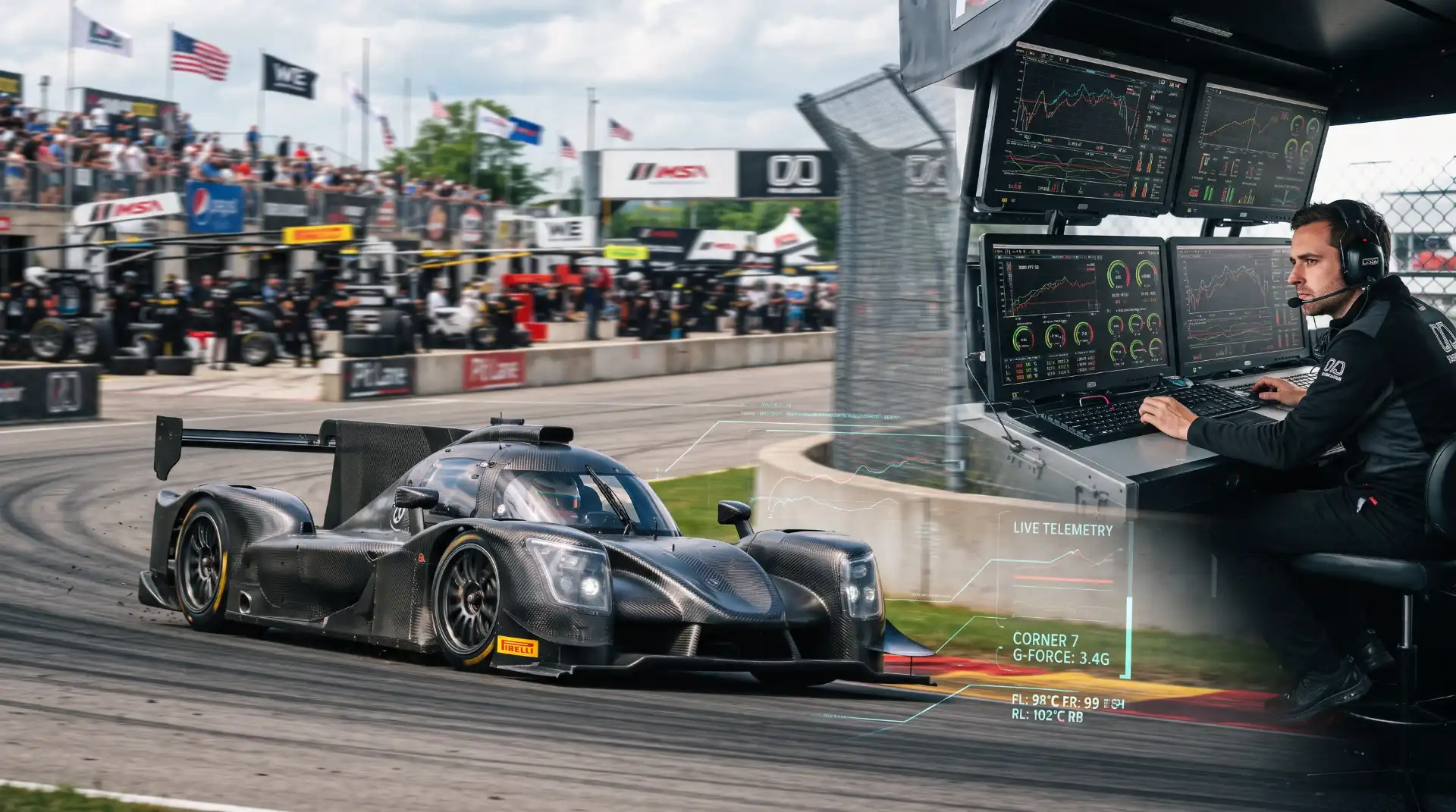
This development is particularly relevant to American motorsport. From professional sports-car racing and endurance competition to club racing, track testing, and advanced simulator programs, data has become an increasingly important part of improving performance. IMSA announced IMSA Labs in 2026 as a platform for motorsport innovation, including work with live race operations, high-volume telemetry, real-time decision engines, race simulations, and AI-assisted operational insights.
The technology does not mean that a computer suddenly understands a race car better than an experienced engineer. Instead, AI is becoming another layer in the engineering process. It can help turn raw information into useful patterns so that human engineers and drivers can make better-informed decisions.
What Is an AI Race Engineer?
An AI race engineer is essentially a software system that uses artificial intelligence and machine-learning techniques to analyze motorsport data and support engineering decisions. Depending on the application, the system may work with telemetry, GPS information, tire data, weather conditions, vehicle setup information, driver inputs, video, lap times, and historical race records.
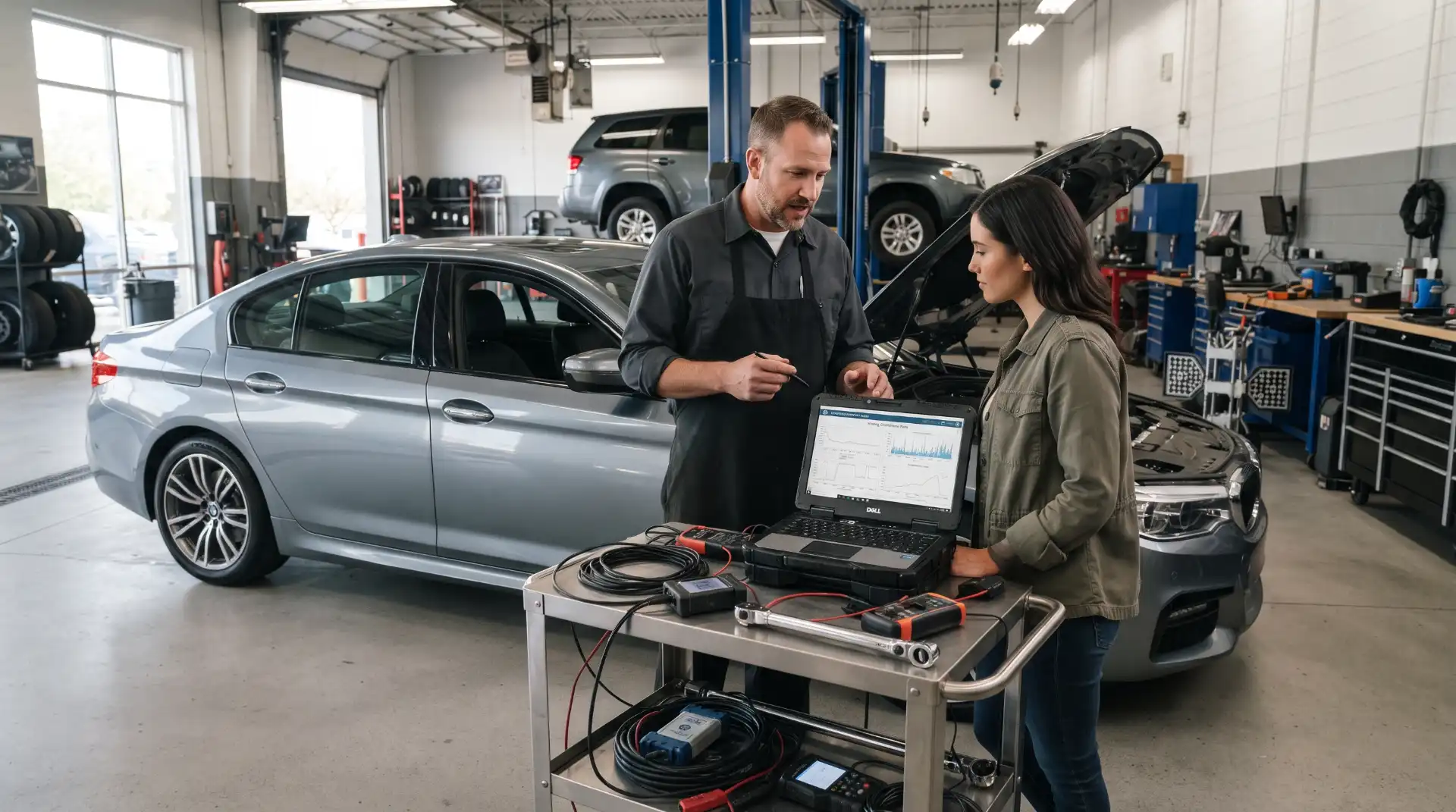
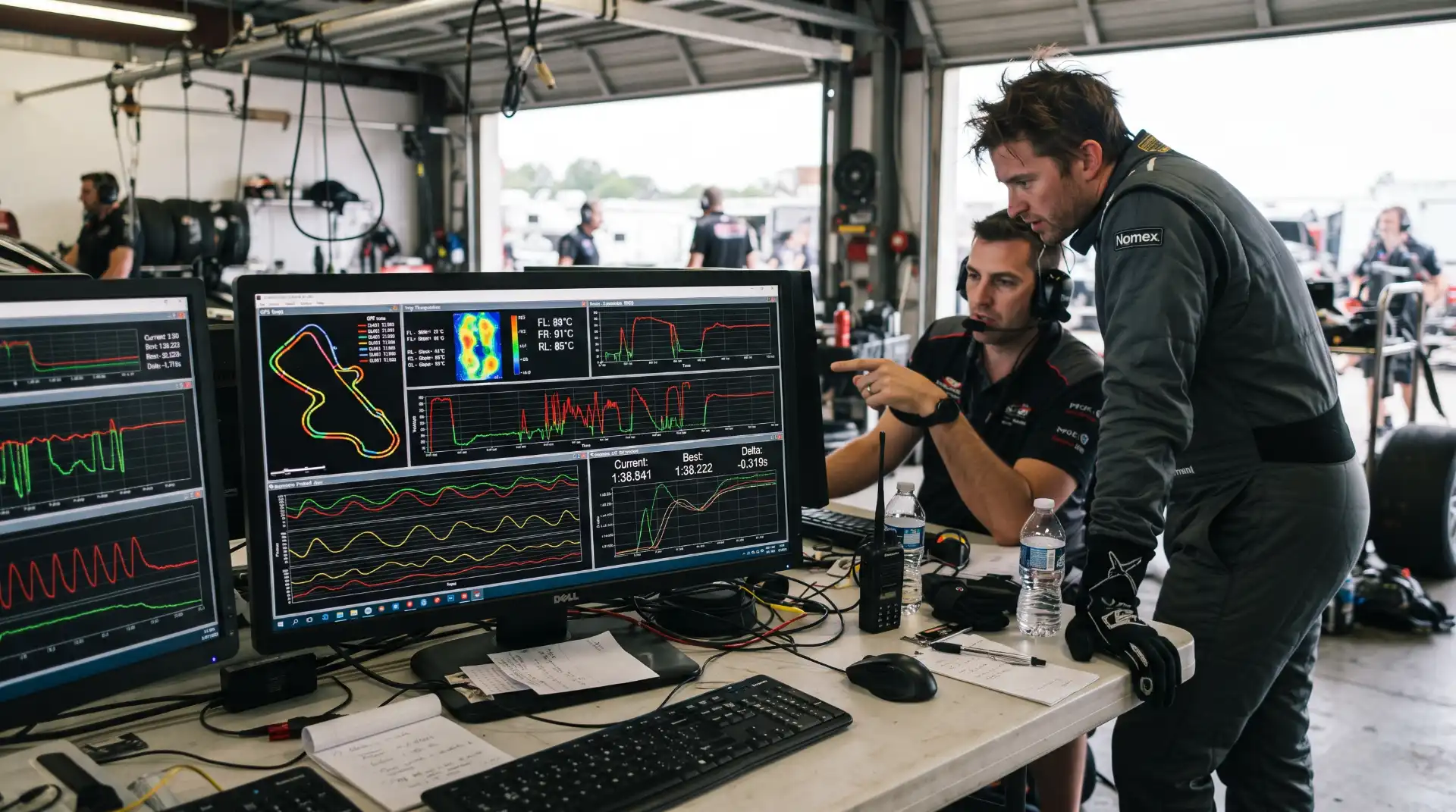
A traditional race engineer might spend hours comparing telemetry traces from different laps. The engineer may examine where the driver applied the brakes, how quickly the throttle was opened, how much speed was carried into a corner, and whether the car behaved differently as tire temperatures changed.
AI can perform many of these comparisons much faster. More importantly, it can search for relationships across large quantities of data that would be difficult to examine manually.
For example, an AI system could identify that a race car consistently loses time in a particular corner when rear tire temperatures rise above a certain range. It could then compare that pattern against suspension settings, tire pressures, track temperatures, fuel load, and driver inputs from previous sessions.
The result is not necessarily an instruction that says, “Change this suspension setting.” Instead, the system may identify a pattern and provide engineers with a starting point for investigation.
Why Modern Race Cars Produce So Much Data
Modern racing vehicles are highly instrumented machines. Sensors can monitor engine parameters, temperatures, pressures, wheel speeds, steering position, brake pressure, throttle position, suspension movement, acceleration, GPS position, and many other variables.
The FIA has described modern motorsport operations as involving large amounts of real-time data. Its work with Catapult and RaceWatch, for example, integrates telemetry, positioning data, video, timing information, and other operational information into motorsport decision-making.
That information is extremely valuable, but more data does not automatically mean better decisions. The challenge is knowing which information matters at a particular moment.
A race engineer may have hundreds or thousands of channels available. During a practice session, the engineer might be interested in tire behavior and suspension movement. During qualifying, aerodynamic balance and driver consistency could become more important. During an endurance race, fuel consumption, tire degradation, traffic, weather, and reliability may become critical.
AI can help organize this information around the question the team is trying to answer.
AI Can Find Patterns Inside Telemetry
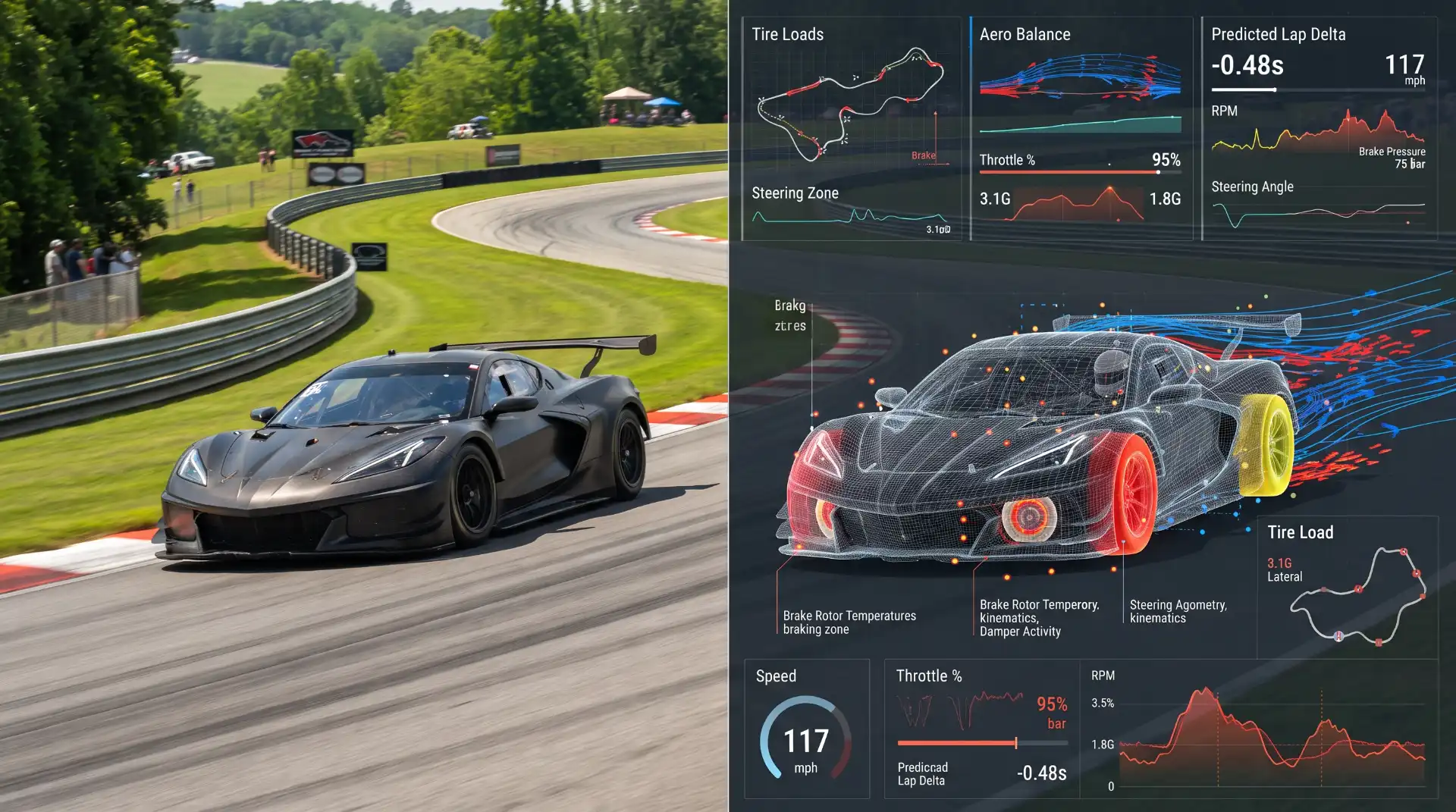
Telemetry analysis is one of the most obvious areas where AI can assist race engineers. A driver may complete dozens of laps during a test session, creating a large collection of data.
Traditional analysis typically involves comparing selected laps. Engineers might choose a driver’s fastest lap and compare it with another run, looking for differences in braking, throttle application, corner entry speed, and exit acceleration.
AI can expand that process by examining many more laps simultaneously.
Instead of simply asking which lap was fastest, an AI system can investigate why certain laps were faster. It can look for recurring relationships between vehicle setup and driver behavior.
For example, a system could discover that a particular suspension configuration produces better performance in medium-speed corners but causes greater tire degradation during longer runs. Another configuration may be slightly slower over one lap but much more consistent over a 30-minute stint.
That distinction is extremely important in racing. The fastest theoretical setup is not always the best race setup.
AI and Race Car Setup
Race-car setup is a series of compromises. Increasing aerodynamic downforce can improve cornering but may reduce straight-line speed. Changing suspension stiffness can improve responsiveness in one section of a circuit while making the car less predictable elsewhere. Adjusting tire pressures can affect grip, temperature, and tire life.
There is rarely one universally perfect setup.
AI can help engineers understand these trade-offs by comparing setup variables against actual performance. A machine-learning model can analyze historical test sessions and determine which combinations have produced useful results under particular conditions.
This can be especially valuable when a team has accumulated data from many circuits and different weather conditions.
Instead of starting every test session from scratch, engineers can use historical information to establish a more informed baseline. The AI may identify previous setups that performed well in similar conditions and suggest areas worth investigating.
The engineer still has to decide whether the recommendation makes sense for the current vehicle and track.
Predicting the Effect of Setup Changes
One of the most interesting applications of AI is predicting what might happen before a physical change is made to the car.
Race teams traditionally rely on simulations, engineering calculations, driver feedback, and controlled testing to evaluate setup changes. AI can add another layer by learning from previous results.
Suppose a team wants to change rear suspension stiffness. An AI model may be able to estimate how a similar change affected the car under comparable conditions in previous sessions.
The model can consider track temperature, tire condition, fuel load, aerodynamic configuration, and driver behavior.
This does not eliminate testing. Racing is too complex for a prediction model to perfectly reproduce every physical interaction. Instead, it can help teams prioritize the changes that deserve attention.
That can save valuable track time.
AI Can Help With Driver Analysis
Race-car performance is not only about the machine. The driver is part of the vehicle’s performance system.
Two drivers can use the same car and produce different lap times because of differences in braking technique, steering inputs, throttle application, racing lines, and consistency.
AI can compare driver behavior against previous laps and identify specific areas where time is being lost.
A driver may be braking slightly earlier than necessary in one corner. Another driver may release the brake more effectively and carry additional speed into the same turn. AI can detect these differences across large datasets and present them in a more structured way.
This connects directly with the growing role of AI in simulator-based driver training. Cars Halton MCC has already covered how AI sim racing coaching is changing real-world driver training, and AI race engineering extends some of the same analytical principles from the simulator into physical race cars.
The combination is powerful because a driver can potentially use simulator data, real-world telemetry, video analysis, and historical performance information as part of one continuous development process.
AI and Tire Management
Tires remain one of the most complicated parts of race-car engineering. Their behavior changes with temperature, pressure, load, wear, track surface, weather, and driving style.
A tire that performs extremely well for one or two laps may not produce the same results over a longer stint.
AI can help teams model tire behavior by analyzing historical temperature data, pressure changes, lap times, cornering loads, and degradation.
For an endurance team, this could be especially useful. A setup that produces slightly less peak grip but preserves tire performance over a long stint may provide greater overall race performance.
AI can also identify unusual tire behavior. If temperatures are developing differently across the four corners of the car, the system may highlight the pattern for engineers to investigate.
The engineer can then determine whether the cause is alignment, suspension behavior, tire pressure, driving style, track conditions, or another factor.
AI and Aerodynamic Setup
Aerodynamics can create another enormous engineering dataset.
Race cars with significant aerodynamic performance can be sensitive to ride height, pitch, yaw, wing settings, floor performance, and airflow conditions. A setup change that appears small can influence the behavior of the car across an entire lap.
AI can compare aerodynamic-related data with GPS traces and driver inputs to identify where a particular configuration provides benefits.
For example, engineers may discover that a higher-downforce setup improves sector two substantially but produces a smaller benefit in sector one because of increased drag.
Rather than looking only at overall lap time, AI can help break the circuit into sections and determine where the setup is creating or losing performance.
This is particularly useful when engineers are trying to optimize a car for a specific circuit rather than searching for a universal configuration.
Weather Data Is Becoming Part of the AI Equation
Weather can dramatically change race-car performance. Track temperature affects tire behavior, air temperature affects engine and cooling performance, and wind can influence aerodynamic balance.
Modern motorsport organizations are increasingly using advanced data systems to incorporate weather into operational decision-making. In 2026, the FIA announced a partnership with Tomorrow.io involving high-frequency weather information, precipitation forecasts, heat and wind assessments, and automated operational playbooks for race control.
For race engineers, weather data can become another variable in predictive analysis.
An AI system could compare historical performance from similar temperatures and wind conditions to help engineers understand how the car might respond.
This becomes particularly important during endurance races, where conditions can change dramatically between the start and finish.
AI and Race Strategy
Race engineering is not limited to setup. Strategy can be equally important.
Teams have to make decisions about pit stops, tire changes, fuel usage, traffic, safety-car periods, weather, and competitor behavior.
AI can process many of these variables simultaneously.
IMSA’s 2026 IMSA Labs initiative specifically identifies real-time decision engines, lap modeling, race simulations, and AI-assisted operational insights as areas of development.
This demonstrates how AI is moving beyond simple post-session data analysis and into live motorsport operations.
Imagine an endurance race where the team is deciding whether to pit before or after a potential caution period. The decision could depend on fuel remaining, tire degradation, traffic, competitor positions, weather, and projected green-flag running time.
A human strategist may have seconds to evaluate those variables. An AI system can continuously calculate possible scenarios and present the engineer with several likely outcomes.
The human team then makes the final strategic decision.
AI Does Not Replace the Race Engineer
One of the biggest misconceptions about AI race engineering is that teams will simply remove human engineers and let computers run the car.
That is not how the technology is most useful.
Race engineering involves judgment, communication, experience, and an understanding of physical systems. A computer can recognize a correlation, but a human engineer has to determine whether that correlation represents a meaningful engineering problem.
For example, an AI model could identify that lap times improved after a suspension adjustment. That does not automatically mean the suspension change caused the improvement. Track temperature may have changed at the same time. Tire condition may have improved. The driver may have learned the circuit.
Experienced engineers understand these confounding variables.
AI is therefore best viewed as an analytical assistant rather than an autonomous replacement for engineering expertise.
The Importance of High-Quality Data
AI is only as useful as the information it receives.
If sensors are inaccurate, incorrectly calibrated, or inconsistent, the resulting model can produce misleading conclusions.
This makes data quality one of the most important parts of AI-assisted race engineering.
Teams need consistent sensor calibration, reliable timestamps, accurate GPS information, properly configured telemetry channels, and well-organized historical records.
Data also needs context.
A lap recorded on new tires should not necessarily be compared directly with a lap completed on worn tires. A qualifying run with low fuel should not be treated as equivalent to a long endurance stint with a heavy fuel load.
The better the team understands the context surrounding its data, the more useful its AI analysis becomes.
AI Can Make Smaller Racing Teams More Competitive
One potentially important benefit of AI is accessibility.
Large professional teams have historically had significant advantages in staffing and data-analysis resources. A major organization can employ specialists in aerodynamics, tires, vehicle dynamics, simulation, electronics, strategy, and data science.
Smaller American racing teams generally have fewer resources.
AI tools could help narrow part of that gap by automating time-consuming analysis.
A club-racing team may not have a dedicated data scientist available for every test day. An accessible AI system could help organize telemetry, compare laps, generate reports, and identify obvious areas for investigation.
This does not eliminate the advantage of experience or budget, but it can make sophisticated analysis more accessible to smaller organizations.
That could become especially important as AI tools move from professional motorsport into grassroots racing.
AI and Track-Day Performance
The technology is not limited to professional racing teams.
Track-day drivers can already use GPS lap timers, onboard cameras, telemetry systems, and simulator software to understand their performance.
AI can potentially combine these sources into a more understandable picture.
A driver could compare braking points from several sessions, examine corner-entry speed, identify inconsistent throttle application, and analyze lap-to-lap variation.
This is particularly valuable because amateur drivers often make setup changes based on assumptions.
A driver may believe the car needs more horsepower when the actual limitation is corner exit technique. Another driver may install a stiffer suspension setup when the problem is actually tire temperature management.
Data can help separate assumptions from measurable problems.
For drivers developing their first serious track car, Cars Halton MCC’s guide on building a reliable track car without chasing horsepower provides a useful companion to the data-driven approach discussed here.
AI Can Help Prevent Unnecessary Modifications
One of the most practical benefits of data-driven engineering is that it can discourage unnecessary modifications.
Motorsport enthusiasts frequently make changes because a particular upgrade sounds faster. More horsepower, larger brakes, stiffer suspension, wider tires, and additional aerodynamic components can all sound appealing.
But every modification changes the balance of the car.
AI analysis can help teams determine whether a particular limitation actually exists before spending money to solve it.
If telemetry shows that a driver is losing most of the time through braking consistency rather than acceleration, increasing engine power may not address the real problem.
If tire data shows that the rear tires are overheating, adding more power could make the problem worse.
The more accurately a team understands its actual performance limitation, the more efficiently it can spend its development budget.
AI and Simulator-to-Track Development
Sim racing is becoming increasingly connected to real motorsport development.
Simulators allow drivers and engineers to test concepts without consuming tires, fuel, brakes, engine hours, or physical track time.
AI can make these simulations even more useful by rapidly testing large numbers of variables.
A team might simulate different aerodynamic configurations, suspension settings, tire conditions, or weather scenarios before choosing a smaller number of options for physical testing.
The real car remains essential because no simulation perfectly reproduces every physical effect. However, simulation can reduce the number of unknowns before the team arrives at the circuit.
This creates a development loop in which simulation, AI analysis, physical testing, telemetry, and driver feedback continuously inform one another.
Why Human Driver Feedback Still Matters
Data cannot describe every aspect of what a race car feels like from the cockpit.
A telemetry trace can show steering angle, brake pressure, throttle position, speed, and acceleration. It cannot completely describe whether the driver feels the rear axle becoming unpredictable during corner entry.
Driver feedback therefore remains essential.
The best AI-assisted engineering process combines quantitative data with qualitative information.
The driver can report that the rear of the car feels nervous under braking. The engineer can then examine brake pressure, yaw rate, suspension movement, tire temperature, and steering corrections to determine whether the data supports the driver’s impression.
AI can help connect the two.
AI and Race-Car Reliability
Performance is not useful if the car cannot finish the race.
AI can also assist with reliability analysis by monitoring trends in temperatures, pressures, vibration, and other sensor data.
A gradual change in a parameter may not be obvious during a single session. However, an AI system analyzing months of historical data could identify that the parameter is slowly moving away from its normal range.
That could give engineers an opportunity to inspect a component before it fails.
Predictive maintenance is already an important concept across automotive and industrial engineering, and motorsport provides an environment where early detection can have enormous value.
For endurance racing in particular, identifying a potential issue before it becomes a race-ending failure can be more valuable than finding another fraction of a second in qualifying pace.
Data Security Will Become More Important
As teams rely more heavily on AI, the value of racing data increases.
Telemetry can reveal vehicle behavior, driver performance, tire strategies, setup decisions, and potentially competitive development information.
Teams therefore need to think carefully about who can access their data and where AI systems process it.
Cloud-based AI platforms can be extremely powerful, but teams may need policies covering data ownership, access permissions, storage, and sharing.
Professional motorsport has always treated technical information as valuable intellectual property. AI does not change that principle. It simply creates another tool that can process and potentially expose sensitive information.
What AI Race Engineering Could Look Like in the Future
The next stage of AI race engineering will likely involve increasingly integrated systems.
Instead of having separate programs for telemetry, tire analysis, weather, video, simulation, and strategy, teams may use systems that combine these information streams.
An AI platform could potentially understand that a tire temperature change occurred at the same time as a suspension adjustment and a change in track temperature, then connect that information with driver feedback and lap-time performance.
That type of integrated analysis could significantly reduce the amount of manual work required to connect separate datasets.
It could also make race engineering more proactive.
Rather than waiting for an engineer to notice a problem, the system could flag an emerging pattern and ask the team to investigate it.
AI Will Change How Engineers Spend Their Time
The biggest change may not be that AI makes engineers unnecessary. Instead, it may change what engineers spend their time doing.
Less time may be spent manually sorting enormous quantities of data. More time can be spent interpreting results, planning experiments, communicating with drivers, and making strategic decisions.
This distinction is important because motorsport engineering is fundamentally an experimental discipline.
The team forms a hypothesis, changes something, measures the result, and decides what to do next.
AI can accelerate the measurement and analysis stages, allowing engineers to move through that development cycle more efficiently.
The Impact on American Motorsports
The United States has a diverse motorsport environment that makes it particularly interesting for AI development.
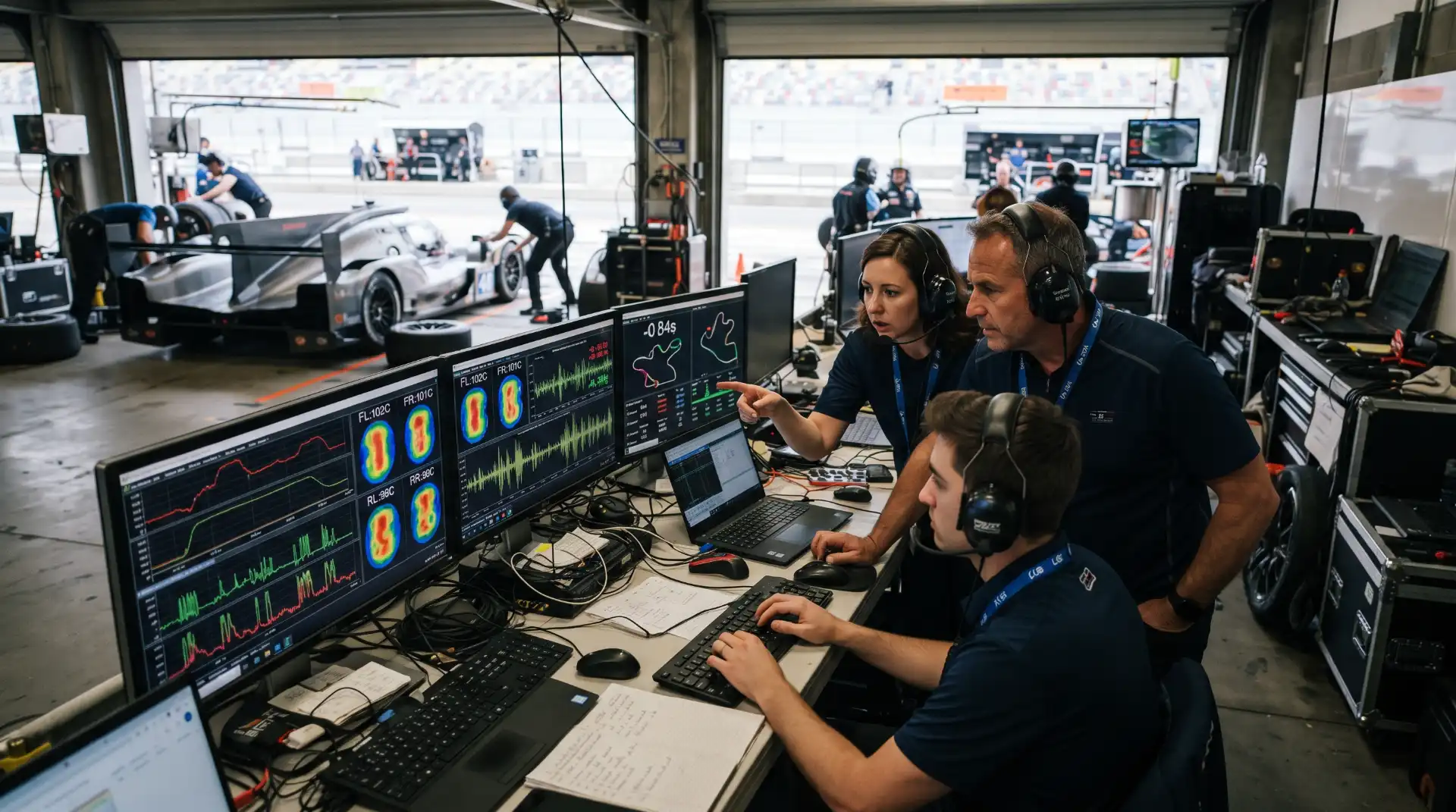
Professional endurance racing, IMSA competition, NASCAR, IndyCar, club racing, autocross, time trials, track days, and sim racing all generate different types of data and engineering challenges.
IMSA’s decision to create IMSA Labs with a focus on technology startups, telemetry, cloud infrastructure, real-time decision engines, and AI-assisted insights demonstrates how seriously advanced data technology is being treated within American sports-car racing.
For grassroots competitors, the long-term significance may be accessibility. As professional motorsport develops better AI tools, simplified versions may eventually become available to smaller teams and individual drivers.
That could change the competitive environment at club level.
AI Is Another Tool in the Race Engineer’s Toolbox
The most realistic way to understand AI race engineering in 2026 is to see it as an extension of existing motorsport engineering rather than a replacement for it.
Race teams have always adopted tools that help them understand their cars. Lap timers replaced stopwatches. Digital telemetry expanded the information available to engineers. GPS made vehicle positioning more precise. Simulators allowed teams to test ideas without always using the physical car.
AI is the next step in that progression.
Its advantage is the ability to analyze enormous amounts of information and identify patterns quickly.
Its limitation is that it still depends on good data, appropriate models, engineering context, and human judgment.
The best results therefore come from combining machine analysis with human experience.
What Race Teams Should Look for in an AI System
Teams considering AI-based engineering tools should focus less on flashy claims and more on practical usefulness.
The system should be able to work with the team’s existing data formats and provide results that engineers can understand. A complicated system that produces impressive visualizations but does not help answer engineering questions has limited value.
Transparency is also important. Engineers need to understand why a system is making a particular recommendation, especially when the decision could affect vehicle reliability or race strategy.
Integration matters as well. AI becomes more useful when telemetry, GPS, weather, tire information, simulation data, and driver feedback can be considered together.
Finally, teams should treat AI recommendations as engineering inputs rather than unquestionable instructions.
The Future of Race-Car Development Is Increasingly Data Driven
Race cars have always been developed through data, but the volume and complexity of that data continue to grow.
AI gives engineers a way to manage that complexity.
In the near future, a race engineer may be able to ask a system a question in plain language and receive an analysis of thousands of laps, setup configurations, tire conditions, and weather scenarios.
The engineer could then choose a specific hypothesis to test at the circuit.
That does not make motorsport less human. In many ways, it could make human decision-making more important because engineers and drivers will have access to more information than ever before.
Conclusion: AI Is Reshaping the Modern Race Engineer
AI race engineers are changing race-car setup and performance by helping teams process telemetry, compare laps, study tire behavior, evaluate setup changes, analyze drivers, model race strategy, and identify reliability trends.
The technology is particularly relevant in 2026 because motorsport organizations are increasingly connecting artificial intelligence with real-time telemetry and operational decision-making. IMSA’s newly established IMSA Labs initiative is one example of this movement, while the FIA has also documented the growing role of AI-assisted analysis and decision support across motorsport.
For American race teams, the most important opportunity may be the ability to turn large amounts of complicated information into practical engineering knowledge. A smaller racing operation may eventually be able to perform analysis that previously required a much larger engineering department.
For drivers, AI can provide another way to understand where lap time is being lost. For engineers, it can accelerate testing and reduce the amount of manual data processing. For strategists, it can help evaluate multiple race scenarios. For endurance teams, it can contribute to reliability and predictive maintenance.
But the human race engineer is not disappearing. Motorsport remains a physical, unpredictable environment where conditions change rapidly and data never tells the entire story. Driver feedback, mechanical knowledge, engineering judgment, and experience remain essential.
The likely future is therefore not humans versus AI. It is humans working with AI.
The race engineer of the future may spend less time searching through telemetry files and more time asking better questions. The driver may receive more precise feedback between sessions. The team may test fewer changes but learn more from each one.
Ultimately, that is what makes AI interesting for motorsport. It is not simply another piece of software. It is a new way of turning the enormous amount of information generated by a modern race car into decisions that can influence performance on the track.
For racers and performance-car enthusiasts in the United States, the technology is worth watching closely. The same data-driven tools now being developed around professional motorsport will increasingly influence club racing, track testing, simulation, and performance driving. The race cars may continue to evolve mechanically, but the intelligence behind their development is becoming just as important.